I turn human-mobility and geospatial data into
evidence-grounded AI for smarter cities.
Research Assistant at the NUS Institute of Data Science, working on spatiotemporal data
mining and smart-city simulation. Previously at LocationMind (Tokyo) and The University
of Tokyo, building geospatial ETL and an early LLM-agent prototype for mobility prediction.
Illustration Next-location prediction from a stay trajectory, with routine history and candidate-location evidence.
News
Latest updates
PinnedJob search
Looking for full-time roles in Singapore
Data analytics, applied AI and smart-city / geospatial roles — where mobility,
spatial and text data meet LLM-agent workflows. Currently a Research Assistant at
the NUS Institute of Data Science; MSc expected Jul 2027.
Submitted our blended-finance proposal to the
LIFT Challenge
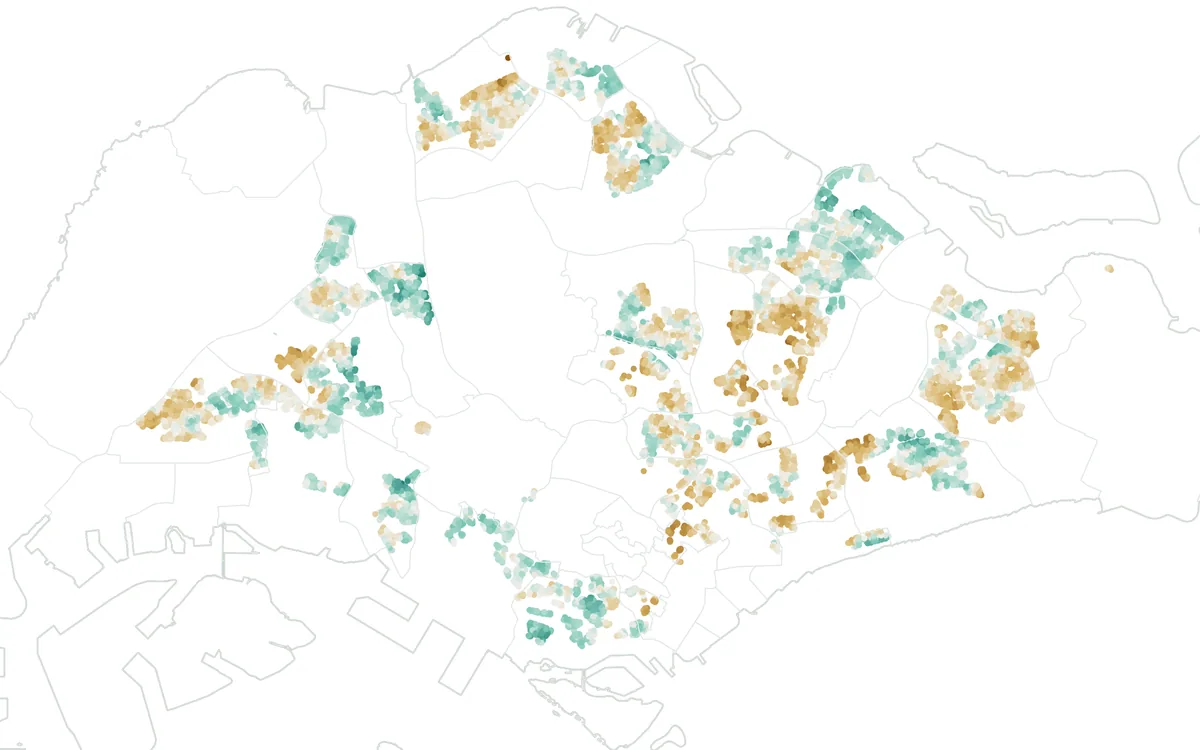
run by the Ackerman Center for Excellence in Sustainability, UNC Kenan-Flagler. UrbanPulse is a
block-level heat-resilience and inclusion index for all 10,749 HDB blocks in Singapore, built
from Landsat, Sentinel-2, OpenStreetMap and 16 data.gov.sg datasets. It adds a community-data
loop and a green-finance model linking verified outcomes to sustainability-linked loans.
24 pts largest inclusion gap hidden inside a town average
Turning raw GPS, POI and urban layers into clean, analysis-ready features.
Built geospatial ETL inputs at LocationMind, Tokyo
Joined urban, socioeconomic & infrastructure layers into POI location features
Trajectory preprocessing across three mobility datasets
Evidence-grounded LLM agents
Designing agents that reason over retrieved evidence — and evaluating whether they actually help.
Built the first AgentMob prototype (API / RAG tool calls)
Benchmarked large multimodal models on satellite-image spatial reasoning
Co-authored a multi-agent, local-RAG clinical assistant (ACM HIDA)
From analysis to decisions
Statistics training plus clear writing — comparisons, diagrams and reports people can act on.
BSc Statistics, Outstanding Thesis (network community detection)
Compared mobility & spatial-analytics methods for product reviews
Publication-ready workflow diagrams and manuscript editing
Featured research
Evidence-grounded mobility prediction with an LLM-driven agent
Mar – Aug 2025 · Information Technology Center, The University of Tokyo · arXiv:2606.05130 ↗
The question
Sequence models capture historical movement well but miss why people travel.
Can an LLM agent add semantic travel intent and geographic context to next-location
prediction — without paying LLM cost on every case?
The approach
Routine cases take a cheap history-based fast path; ambiguous ones go to tool-assisted
reasoning that gathers evidence — recent context, historical behaviour, stay/move
likelihood and candidate-location profiles — across three mobility datasets.
My role
Scoped the research question and designed the initial workflow.
Built and validated the first Python pipeline: trajectory preprocessing → context construction → API-based LLM/RAG tool calls → evaluation.
Ran feasibility experiments, analysed failure cases and documented directions the team later optimised.
Two-path design: a cheap lookup where behaviour is regular, an evidence-gathering agent where it is not.
Experience
Research and industry, across Singapore and Japan
IDS
Institute of Data Science (IDS), National University of Singapore
Research Assistant · Mentor: Prof. Ng See Kiong
Sep 2026 – PresentSingapore
Contribute to research on spatiotemporal data mining and smart-city (Simulation & AI) applications.
LM
LocationMind Inc.
Development Intern
Jul 2025 – Mar 2026Tokyo, Japan
Built ETL inputs for multidimensional geospatial datasets, covering ingestion, cleaning, transformation and analysis reporting.
Joined urban, socioeconomic and infrastructure layers to produce commercial POI location features; compared mobility-prediction and spatial-analytics methods for product and architecture reviews.
Benchmarked large multimodal models on spatial reasoning with satellite imagery and geographic context.
Geospatial ETLPOI featuresLMM benchmarking
ITC
Information Technology Center (ITC), The University of Tokyo
Collaborative Research Assistant · Mentor: Prof. KOBAYASHI-HILL Hiroki
Mar 2025 – Aug 2025Chiba, Japan
Drove early-stage research on an LLM-agent system for human mobility prediction — from scoping the research question and designing the initial workflow to prototype implementation and feasibility experiments.
Reviewed and presented recent literature in lab seminars, synthesised research directions, and contributed to cross-disciplinary collaborations spanning human mobility, LLM agents and medical AI.
Independently collected and structured 1.8 million Japanese horse-racing records covering ~270,000 races, and constructed a pedigree network with over 100,000 nodes.
LLM agentsHuman mobilityNetwork analysis
Selected projects & publications
Cities, agents and networks
Case competition · LIFT 2026 · Team project
UrbanPulse: who does a plan cool?
Block-level heat-resilience and inclusion index for Singapore's 10,749 HDB blocks — six pillars from 89 Landsat scenes, Sentinel-2, a shade-mapped OSM walking network and 16 data.gov.sg datasets, weighted by where seniors and rental households live — plus a green-finance business model.
MACA-PA: Modular Agent-Based Clinical Assistant for Perioperative Anesthesia
A locally deployable multi-agent, RAG clinical assistant: a root agent routes tasks to specialised agents for clinical summaries, CRF generation and medical-history classification.
My part Publication-ready workflow diagrams (task routing, local-RAG prompt assembly, agent coordination); edited and rewrote manuscript sections for technical and clinical consistency.
Jiang, Y., Ma, C., Xu, Z., Mu, D., Ni, L., Kobayashi, H. Proceedings of HIDA 2026, ACM.
Used embedding-based representations to explore potential gender differences in research-field patterns among researchers with comparable research performance.